


Navigating a World Rewired

Read why we remain steadfast in our belief that diversification is your best protection against the unknown.

Over the last several years, US investors have operated in a Goldilocks economy featuring steady economic growth, strong earnings, and falling inflation. However, Goldilocks' three bears arrived in March. Despite a last day surge, US equity markets moved beyond just volatility into correction territory — defined as a 10% or greater drop from a recent high. The S&P 500 fell 5.1% for the month, the DJIA, 5.4%, and the NASDAQ 4.8%. While “correction” sounds foreboding, it is often a healthy, albeit painful, mechanism for removing froth from a market that had become numb with complacency.
What’s driving the selloff?
A convergence of energy shocks, a repricing of private credit, and escalating conflict in the Middle East are the primary drivers. At the recent ALTSLA conference, the CAIA Association described this shifting landscape as a “world rewired” — a fundamental restructuring of global systems from trade to technology to finance. We’re moving from globalization to regionalization, where resiliency is prioritized over efficiency and where the background noise of geopolitics has moved to center stage.
Recall that at the start of the year, investors expected a soft landing followed by a series of rate cuts. The conflict in the Middle East has shattered that optimism and pushed crude oil prices past $100 per barrel, reviving fears of 1970’s style stagflation. The 10-year US Treasury yield recently hit 4.46%, its highest level since mid-2024, as the market prepares for higher for longer all over again.
In the technology sector, AI-centric stocks are seeing a valuation reset. The massive amount of capital that poured into AI over the last 18 months is finally being scrutinized for immediate returns. As long-term interest rates climb towards 4.5%, the present value of future earnings for technology and growth stocks has naturally compressed.
This brings us to private credit — loans provided directly to companies by non-bank institutions. Over the last five years, this asset class has ballooned into a $2 trillion market, largely replacing traditional bank lending for middle market companies, including those that are software/AI related. Today, that market is being stress-tested as fears of advancements in AI threaten traditional software companies. Recent headlines have focused on a significant performance dispersion, with default rates predicted to climb to 8% or even higher. Additionally, increased liquidity friction has made news as several prominent funds have limited investor withdrawals to protect their underlying assets.
All private credit is not created equal
At Ellevest, the strategies our clients are invested in differ vastly from the traditional options dominating the headlines. Investors’ primary concerns involve tech-heavy portfolios where AI will disrupt routine software functions and entry-level roles, and undermine the long-term operational stability and profitability of these firms. In contrast, Ellevest private credit investments are highly diversified and include:
- Revenue or contract-based loans: These are repaid through firm revenues or receivables bound by strong contracts, showing little to no sensitivity to interest rate movements.
- Emerging markets: With a focus on regions where private credit remains structurally strong, with hedges to minimize currency fluctuations.
- Affordable housing financing: High demand for affordable housing mitigates the risk of loss, providing a defensive ballast to the portfolio.
These private credit strategies have their own set of unique risks, but are vastly different from the type of private credit strategies dominating headlines today.
A world rewired
The most significant shift this past month is the escalation of hostilities involving Iran.
Traditionally, geopolitical shocks follow a predictable pattern with a sharp sell-off followed by a rapid V-shaped recovery as the market realizes the global supply chain remains intact. The chart below shows the market behavior for past Middle East geopolitical shocks.
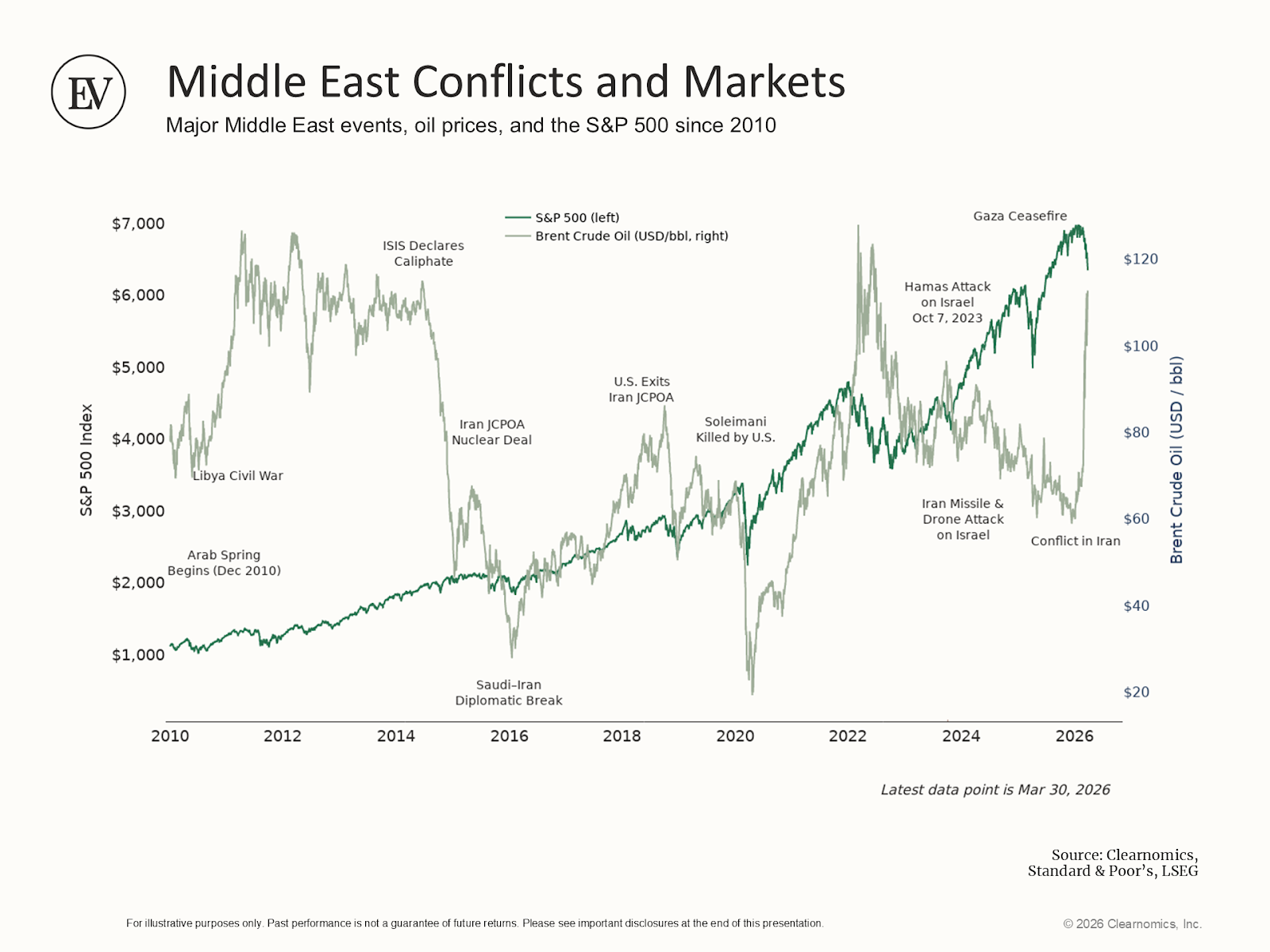
Is it different this time?
The conflict in Iran is a direct threat to the Strait of Hormuz, the world's most vital energy passageway. The world is moving away from globalization to regionalization. World power is dispersing, with alliances shifting based on security and shared values rather than just economic integration.
Supply chains are being rebuilt to prioritize resilience and national security over cost minimization. Trade is increasingly dictated by sanctions, export controls, and strategic competition. And the AI race is being dictated by geopolitical alliances rather than pure market forces. Geopolitical risk is no longer a footnote. Fundamental changes are happening in the global system that challenge our old assumptions and beliefs. And those changes are likely to have long-term implications.
But a world rewired doesn’t mean gloom and doom. It means we need to think differently, let go of what we think we know from the past. While March markets were down, the underlying earnings power of the American economy remains robust. The AI revolution hasn't stopped, nor has the energy transition. The fundamental engines of growth led by the AI infrastructure build-out and a resilient US consumer remain intact. US exceptionalism may be tarnished but it still shines, albeit less brightly.
A portfolio for a rewired world
You’ve heard us say that no one can predict the markets, and that is doubly true for geopolitical conflicts. We remain steadfast in our belief that diversification is your best protection against the unknown … and that is never more critical than today.
While public markets (stocks and bonds) are hyper-reactive to headline news, they remain the essential drivers of long-term growth. As the world fragments, international exposure will play an even more critical role in balancing domestic volatility. Alternatives (from real estate to private credit) offer risk profiles with low correlation to public markets, providing a necessary buffer. However, as we have seen recently, discerning among these options is the key to navigating this new landscape. We aren't just diversifying for the sake of it, we’re building for resilience.


About Ellevest
Founded in 2014, Ellevest is a financial services company on a mission to get more money in the hands of women, their families, and the next generation through personalized, intentional wealth management, and financial planning.


.png)
.png)
