


The Power of Portfolio Resiliency

Read why when the daily headlines feel overwhelming your best defense is a well-constructed plan.

Vibe-coding turned into a vibe-check for February’s markets. After months of AI-fueled adrenaline, investors spent the month looking under the hood and asking tougher questions. That brought a sell-off in software businesses, tech companies, and financial firms that invested in or are being threatened by AI technology. The market is shifting from AI hype to AI reality. The S&P 500 finished the month down nearly 1% while the NASDAQ, the tech-heavy barometer, felt the brunt of the volatility, falling 3.4%.
But just as investors were digesting this tech-sector rotation, a major geopolitical event over the weekend abruptly shifted the market’s focus.
Geopolitical Ripple Effects and Energy Markets
This weekend's US-Israeli military operation that resulted in the deaths of Iran's Supreme Leader Ali Khamenei and 40 top officials will certainly have ranging macroeconomic implications. For financial markets, this has led to a spike in volatility: global stock markets opened down more than 1%, gold rallied back up to $5400, and oil climbed north of $70/barrel as of Monday morning.
That last market is key: the primary risk here lies within global energy markets. Iran controls the Strait of Hormuz, a critical transit point for 20% of the world's oil and natural gas. JP Morgan estimates a sustained price spike in oil could introduce a 1-1.5% headwind to both inflation and overall US GDP growth. Fortunately, recent below-average oil prices (in the $60s) driven by strong global supply offer a short-term buffer if a resolution takes time. Furthermore, Iran's own economy relies heavily on oil revenues brought in from transit through the Strait which incentivizes them to keep it open.
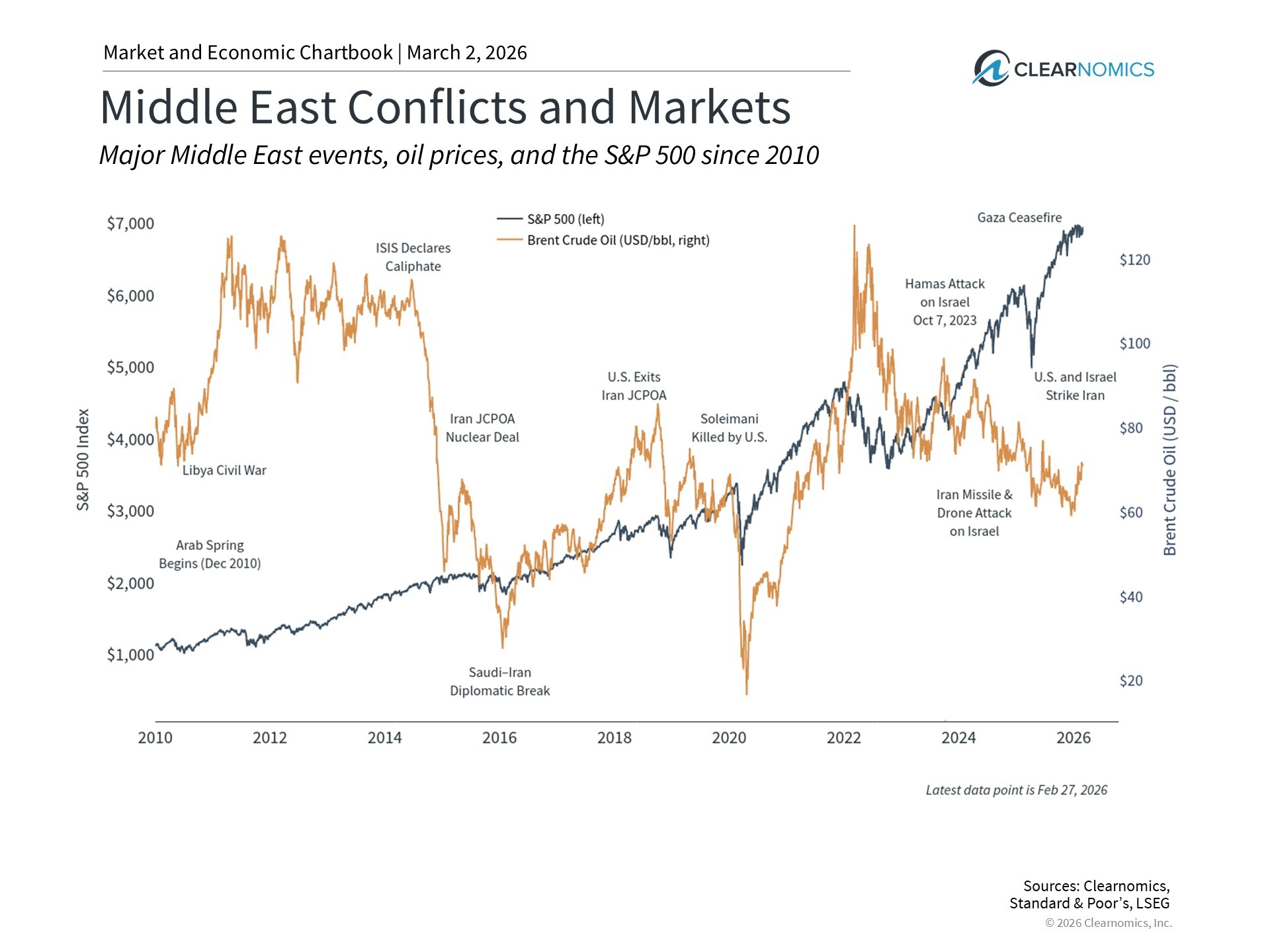
However, a key challenge for de-escalation is the current leadership vacuum in Tehran. Similar to recent geopolitical strategies observed in Venezuela, the US administration appears aimed at paving the way for a Western-friendly government, though the timeline to stability remains unclear.
The Power of Portfolio Resiliency
Regardless of the specifics, it is always important to remember that volatility stemming from geopolitical events tends to be short lived. Concerns about escalation are entirely valid. Yet, through countless crises, wars, pandemics, and recessions, investors who have maintained discipline and stayed the course have ultimately seen markets recover from human progress, innovation, and long-term economic growth.
When the daily headlines feel overwhelming, whether it's a rapid recalibration of AI valuations or sudden conflict in the Middle East, your best defense is a well-constructed plan. This is exactly why we relentlessly advise on the benefits of asset allocation and diversification while investing. A balanced portfolio isn't designed to predict the future, it’s built to withstand it.
A well-diversified portfolio was designed for exactly this kind of moment, not just in theory, but in practice. When equities sell off, bonds typically cushion the blow. When the dollar weakens on geopolitical uncertainty, international assets and commodities act as a counterweight. When growth stocks get punished, as we saw all of February during the AI reality check, value stocks, and dividend-paying companies hold their ground.
If you built your portfolio with diversification in mind, it’s probably helping you right now. That's not luck. That's asset allocation working, as intended.


About Ellevest
Founded in 2014, Ellevest is a financial services company on a mission to get more money in the hands of women, their families, and the next generation through personalized, intentional wealth management, and financial planning.

.png)
.png)
