What the Canary Is Really Telling Us

Unpacking the latest market moves, and whether this is the canary in the coal mine for the AI trade.
CoreWeave, a company that rents out AI computing power, watched its bonds sell off hard in October. That led many people to ask whether it’s “the canary in the coal mine” for the AI trade. The idiom has been used so frequently that it took me down a rabbit hole to learn where that phrase actually comes from. Apparently, British coal miners carried canaries underground until 1986. Canaries breathe fast, so carbon monoxide got to them first. But the canaries only reacted to one thing. A struggling bird meant bad air in that part of the mine, it didn’t mean the whole mine was about to collapse.
October’s numbers tell a similar story, once you look at where the damage landed. The S&P 500 fell only 0.9%, but the tech-heavy Nasdaq fell 5.3%. Chip stocks slid, several AI infrastructure IPOs were delayed or pulled, and the 10-year Treasury yield touched 5.36% on October 7, 2026 before easing back under 5%. Then the month ended with a thud. Earnings from Alphabet, Amazon, and Intel renewed worries about how much AI is costing, and on October 30, 2026 alone the Nasdaq fell 2.9%. But not everything went down. Consumer staples and healthcare stocks rose, and Treasury yields fell as investors looked for safer places to park their money.
That got me to thinking, if CoreWeave really is the canary, what exactly is it reacting to?
Canary signals
First, some background. CoreWeave is what the industry calls a “neocloud” (aka a company that fills data centers with AI chips and rents that computing power out to others). It has grown incredibly fast, but largely with borrowed money (roughly $50 billion of debt) and it still isn’t profitable.
In mid-October, investors started to wonder whether it could keep up with all that debt. Yields on its bonds due in 2031 shot past 16%. (Yields rise when bond prices fall, and a yield that high usually means the market thinks a company is in real trouble.) The stock fell nearly 25% in a single week.
Alphabet, Amazon, Microsoft, and Meta plan to spend about $725 billion on AI infrastructure this year, and estimates for next year top $1 trillion. When that much money pours into one theme, not every company on the receiving end is going to make it. And this early into the AI buildout, we should expect a few blowups. But that doesn’t mean the whole ecosystem is in trouble. Plenty of companies that laid fiber-optic cable in the late ’90s went bust. The internet they built it for turned out just fine.
It’s also worth noticing who got hit first and why. CoreWeave isn’t profitable, so it has to borrow to build. When borrowing gets more expensive (and with the 10-year near 5%, it has), the company that needs to borrow feels it first. That’s what this canary was reacting to. AI spending outrunning the cash to pay for it. By month’s end, that same question had reached Alphabet and Amazon, which are now spending more cash than their businesses bring in. Investors are rethinking how much they’re willing to pay for all that spending … but that isn’t a sign that AI doesn’t work, or that the whole market is in trouble. After all, S&P 500 earnings are still on track to grow about 30% this quarter.
Will midterms have an impact?
One of the more consistent issues this election season has been data centers. Voters in both parties have pushed back on them, over electricity bills, water use, and plain old “not in my backyard.”
And the election outcome might matter less than one would think. Most of the critical data center decisions (power hookups, permits, etc) get made at the local level, and the major constraints around power, supply chains, or financing costs aren’t going anywhere. The bigger takeaway is that building AI infrastructure is getting slower and more expensive regardless which party is in charge. That might slow things down, but it won’t stop the buildout altogether.
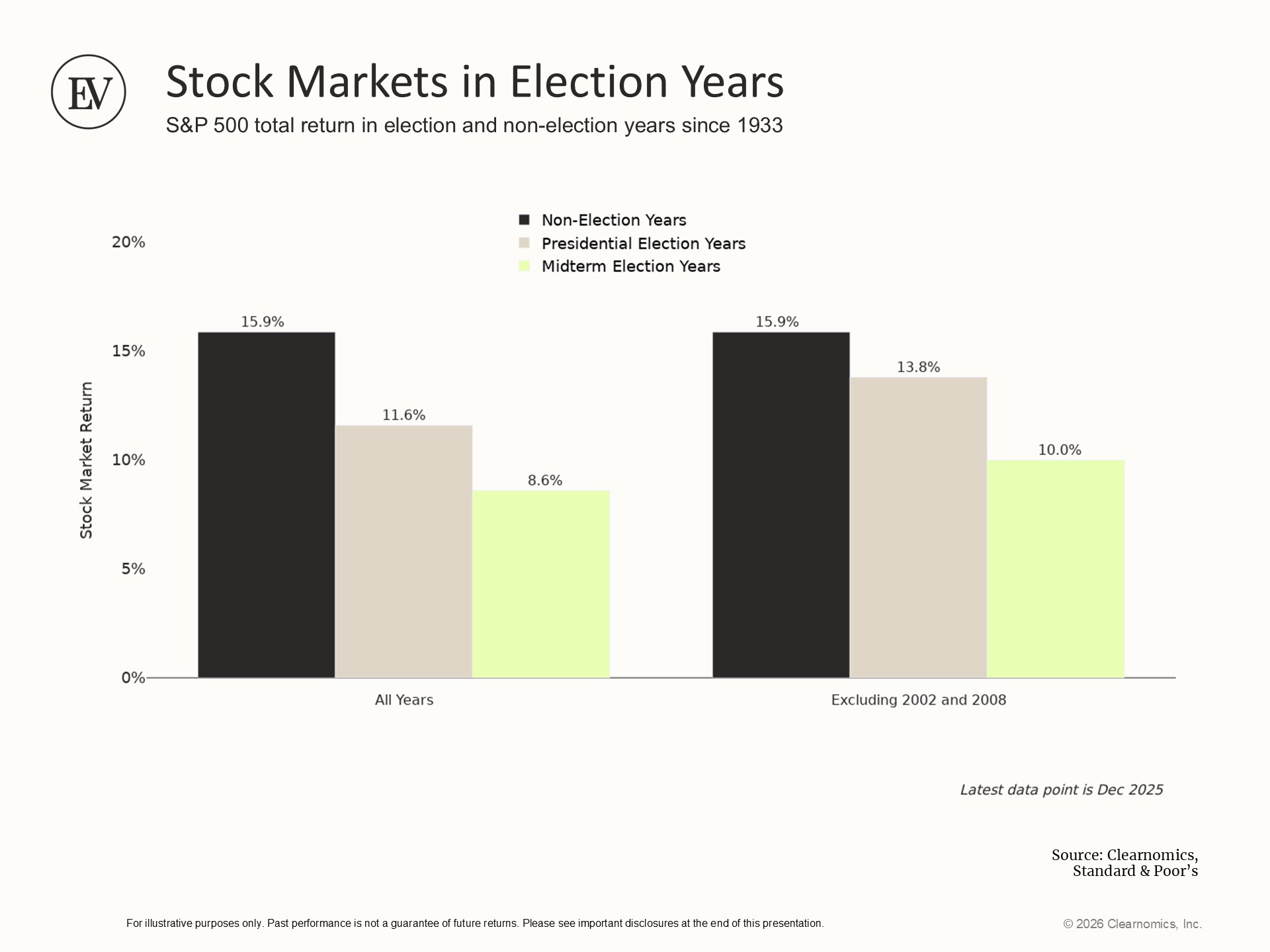
As for markets more broadly, history is fairly reassuring. Midterm years have historically shown volatility leading up to elections, and while midterm years have been the softest of the cycle, the S&P 500 has still averaged a 10% total return since 1933 (excluding 2002 & 2008) in those years. And in non-election years, for those looking forward to next year, the S&P 500 has averaged 15.9% over that same time period. Regardless, over the long run, earnings and the economy have mattered far more than elections.
How do I avoid AI risk?
If you’re still feeling a bit uneasy, I can’t blame you. AI is moving at light speed. Concerns around job loss and other AI doom scenarios are common. Even if you’ve never bought an AI stock on purpose, you probably own plenty as the top tech names make up close to 40% of the S&P 500. Trying to avoid AI risk will be hard, but the good news is there are areas in a diversified portfolio that seem purpose built to hedge against AI risk.
Lean toward value sectors
Value stocks are companies that trade at lower prices relative to their earnings. Think healthcare, consumer staples and financials. They’ll likely benefit from AI usage, but their fortunes don’t hinge on whether the buildout keeps going at full speed. That can help cushion you from one-off blowups like CoreWeave’s. However, not every "value" sector is AI-light. Utilities and industrials have become AI trades in their own right, since data centers need enormous amounts of power and equipment.
Look overseas
International markets have far less exposure to big tech, and they’re cheaper. International stocks trade at roughly a 25% discount to US stocks based on expected earnings. Developed markets outside the US are another way to gain exposure while staying invested.
High-quality bonds
Bond yields are the highest they’ve been in about two decades. And if you look under the hood, the rise in rates has been less about inflation than most think. The jump has come from "real" yields, the part that reflects growth and the cost of money. If big tech pulls back on spending and growth slows, real yields could come down, and bond prices go up when yields go down.
Just keep in mind, if the AI trade turns positive again, these segments of the market might lag.
Clearing the air
A struggling canary meant bad air in one part of the mine. It didn’t mean the whole mine was coming down. October was a lot like that. The bad air drifted from CoreWeave to some of the biggest names in tech, but it stayed in the AI corner of the market. Even on the month’s worst day, plenty of stocks went up. AI is likely to go through good phases and bad ones, and so will the headlines.
And as always, we’ll keep an eye on the canaries, so you don’t have to.


About Ellevest
Founded in 2014, Ellevest is a financial services company on a mission to get more money in the hands of women, their families, and the next generation through personalized, intentional wealth management, and financial planning.