Why “Gender Parity” Isn’t Always Enough

When it comes to women in sports, representation falls short. Here’s a short history of women in the Olympics.
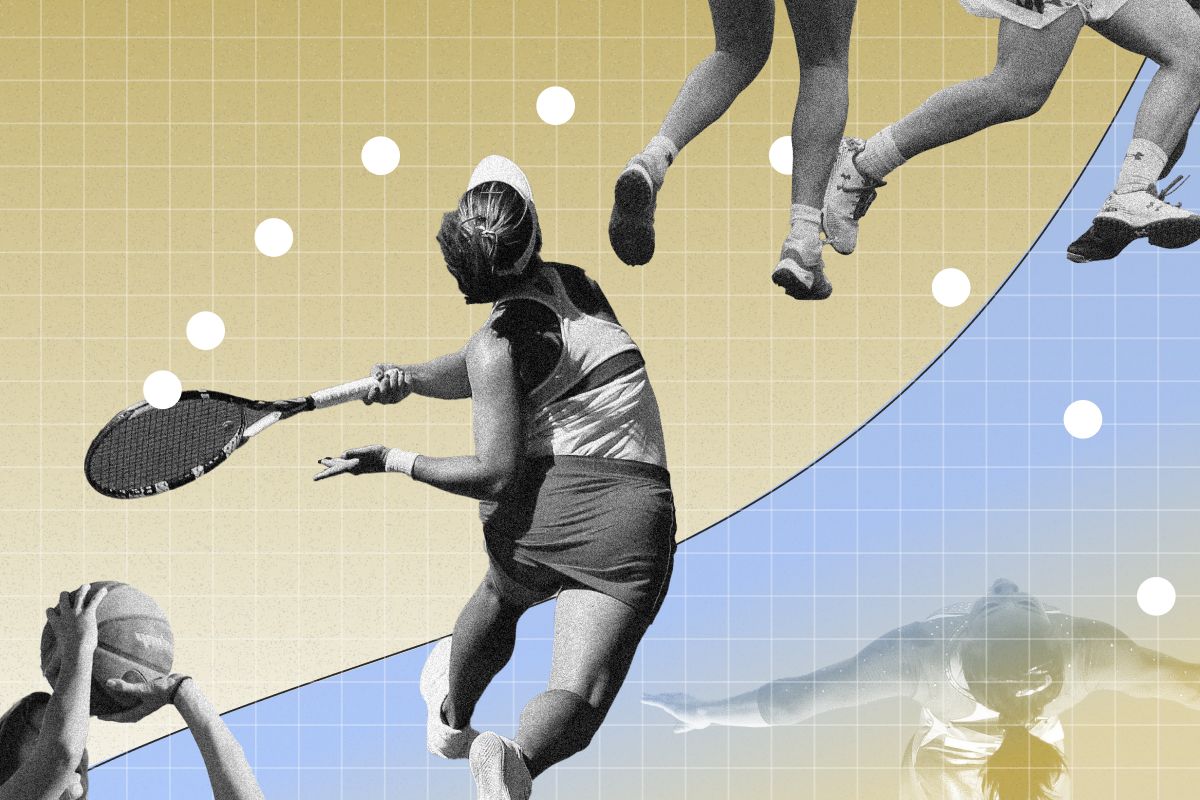
There’s no doubt about it: Women are not only dominating the Olympic Games, they’re dominating almost all the conversations about it.
From Simone Biles’ comeback to Suni Lee’s growing medal collection to Lauren Scruggs’ history-making win, the biggest headlines have been about women.
One of the most iconic images to emerge is of Simone Biles and Jordan Chiles bowing down in respect to gold medalist Rebeca Andrade on the first all-Black podium in men’s or women’s gymnastics at the Olympics.
Then there’s Kristen Faulkner, a former venture capitalist who won the women’s road race after joining Team USA as a replacement. And what about swimming champion Katie Ledecky, who can’t stop breaking records?
In Paris, women have been changing the game and giving everyone a run for their money. But that doesn’t mean it’s all rosy for women athletes.
Sexism rears its ugly head at the Games
You probably know what we’re talking about: We heard a male presenter say to Hungarian sailing competitor Mária Érdi, “Let’s see a smile,” as she won the race with an impressively stoic expression.
Another commentator was suspended for making a sexist remark about women participants of the 4x100-meter freestyle relay “hanging around, you know, doing their makeup.”
Yet another French commentator was dropped for using tired clichés to describe tennis Olympian Sara Errani, claiming, “She does everything: the washing up, the cooking, the mopping up.”
And, of course, no one was able to escape the dehumanizing conversation about the biological realities of Algerian boxer Imane Khelif, which sought to discredit her win.
We could go on and on, unfortunately. From inherent bias in filming women athletes to the undue focus on their clothes and appearance, sexism is still very much alive at the Olympics. It seems like women can’t be winners without getting punished for it.
Sure, the Olympics have come a very long way. This year, we celebrated almost full “gender parity” at the Paris 2024 Games.
But representation is just one step in the direction of progress. Women need more than just representation.
A short history of women in the Olympics
Women first entered the Olympics in, coincidentally, Paris in 1900 — about six years after the first Olympic games were held. Out of 997 athletes, 22 were women. They could qualify for only five competitions: tennis, sailing, croquet, equestrianism, and golf. Women in the leisure class had normalized participation in these sports, so they were deemed “acceptable” sports for women to compete in.
Even this calculation was made with women’s appearances in mind. According to the National Women’s History Museum, “These endeavors were also more socially acceptable because they required elaborate outfits, stamping an assurance of femininity onto competitors in costume.” (Sound familiar???)
Still, even in their “elaborate outfits,” women athletes couldn’t silence the critics. “You could see in the personal correspondence among the organizers of the Olympics that they were revolted by the presence of women, even though they had to give in and allow them to participate,” David Goldblatt, author of The Games: A Global History of the Olympics, told Fast Company.
That year, in 1900, American-born Swiss sailor Countess Hélène de Pourtalès became the first woman ever to win an Olympic medal. (Her husband, Hermann, was part of her crew onboard.)
When the Olympics took place in America only four years later, in St. Louis, MO, women could only participate in one, singular event: archery. Matilda Scott Howell became the first woman to win a gold medal during the event that year. She also holds the distinction of being the oldest person to compete in an archery event at the Olympics, because she continued competing into her 70s.
Some of the greatest challenges for women athletes were still to come.
In the 1940s, international sports bodies began introducing the concept of “sex testing.” Women athletes had already been subject to undue scrutiny about the validity of their gender. In 1937, a feature in Look Magazine titled “When Is a Woman Actually a Woman? Today’s Chief Worry Among Athletic Officials” was published, featuring a photo of two-time Olympic champion runner Helen Stephens. A few years later, they introduced chromosomal testing, which was banned in the ’90s and eventually replaced by testosterone testing — used to stigmatize and disqualify runner Caster Semenya from running in world competitions.
It wasn’t until 1948 that the first woman of color from any country won an Olympic medal. And that icon was Alice Coachman, a Black woman who grew up in segregated Georgia. Coachman fought both structural racism — she wasn’t allowed to train in the same facilities as her white counterparts, so she trained barefoot on dirt roads — and sexism. Her parents punished her for participating in what they thought was an “unladylike” sport.
Still, she made it to the London Olympics in 1948 and won the gold medal in the high jump competition. She also set a new record: She cleared the 5 foot 61/8-inch bar on her first try.
From there, greats like Herma Szabo (the first-ever woman Winter Olympic champion); Debbie Meyer (the first woman swimmer to collect three individual gold medals); Nadia Comaneci (the first gymnast to be awarded a perfect score of 10.0 at the Olympic Games); Sarah Attar (one of the first two women athletes ever to represent Saudi Arabia at the Olympics); and Kinue Hitomi (the first Asian woman to become an Olympic medalist) continued setting records and making firsts in Olympic history.
How change happens
There are echoes of the challenges women faced in the early 1900s in the challenges they face today. Today, women’s uniforms are unduly scrutinized and sexualized. Today, women athletes face ugly examinations and audits of their biological sex. Today, many women Olympians are still fighting for equal pay, equal treatment, and equal opportunities.
Representation isn’t enough. Women need the power and money to change these realities.
Take, for example, the first-ever nursery at Olympic Village, brought to you by runner and sprinter Allyson Felix. This wouldn’t have been possible without a partnership with Pampers — and a massive investment from Melinda French Gates (an Ellevest investor) herself.
And this year, thanks to French judo star Clarisse Agbegnenou, breastfeeding parents will, for the first time, have lactating rooms where they can privately breastfeed their children. The expense amounted to just 40,000 euros (about $43,000), a drop in the bucket for an event that has a budget of billions.
It’s like we always say: When women have more money, we’re all better off.
Book a complimentary consultation with a financial expert on Ellevest’s all-women team for help determining your next steps to reach your goals.


About Ellevest
Founded in 2014, Ellevest is a women-founded, women-led financial services company dedicated to closing the gender wealth gap. Our mission is to get more money in the hands of women, their families, and the next generation through personalized, intentional wealth management, and financial planning.